The sooner you do your year end, the more it is worth
By Andrew Isaacs, CIMA Member in Practice ·

Every limited company has to file a year end. For most small business owners it is the only proper look at their finances they get all year, and it usually lands nine months or more after the year actually ended, filed close to the deadline because nothing forced it sooner. By the time you see it, the story it tells is already history. We think that wastes the single most valuable thing your business quietly produces, so we do it differently in two ways. We read it rather than just file it, and we get it done as early as we can.
Old numbers cannot change anything
The value of a number is highest when it is fresh. A figure about last month can still change what you do next month. A figure about a year that closed nine months ago can only be regretted. That is the whole case for doing your year end early. The sooner it is done, the sooner you can act on what it shows, while there is still room to do something about it.
This is not a small problem. Nearly two in five UK small business owners say they did not know whether their business was profitable in the previous month (Xero, 2025). If that is true of last month, a set of accounts arriving the following winter was never going to help. So we turn the year end around quickly, and for the parts that matter more often than once a year we add a simple monthly view. The earlier and more often your numbers are read, the more power they carry.
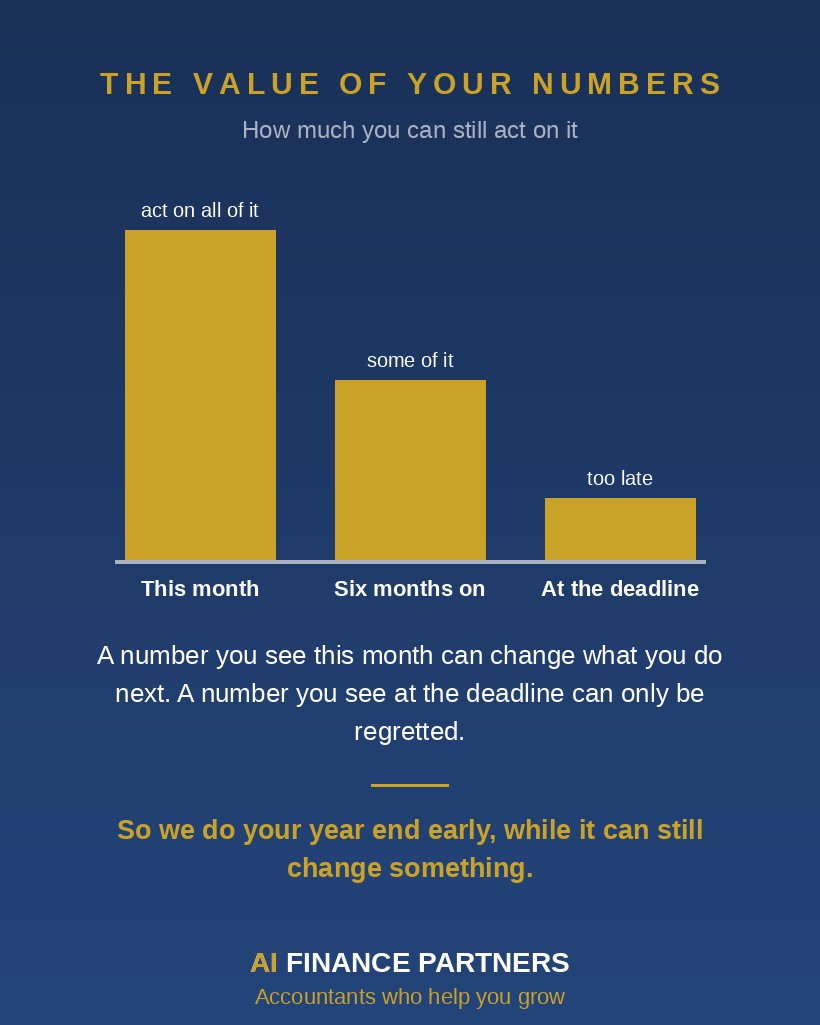
The later you read your numbers, the less you can do about them.
It starts with timely books
None of this works on stale books. The insight everyone wants sits inside the bookkeeping, and it is only worth having if the bookkeeping is done properly and kept current. Books that are three months behind cannot tell you anything you can still act on. So we keep them clean, reconciled and up to date, because that is the raw material everything else is made from.
Nobody ever made a good decision from books three months out of date.
A forward view of your cash
Once the books are current we can look forward as well as back. A simple cash forecast shows you the next few months rather than leaving you to find out when the balance drops. You see the quiet quarter coming, the VAT bill that lands the same week as payroll, the point at which you can actually afford to hire or invest. That is what lets a business grow when it is ready, on purpose and from a position it understands, rather than lurching at growth and hoping. Planned growth is a great deal safer than growth that just happens to you.
What we pull out of your year end
At the top level your accounts tell you a great deal. Your margin and which way it is moving, what your overheads are really costing you, how much cash the business is holding, how long your customers take to pay, and how this year compares with the last three and with others in your sector. We read all of that and hand it back in plain English, with what it means and what we would do about it. What the year end cannot do on its own is tell you which product or which customer makes the money. That needs management accounts through the year, a different and more regular piece of work, and we will tell you honestly when that is what you need rather than pretend the year end covers it.
A business that runs on its numbers
Put those pieces together, the current books, the forward view of cash, the year end read properly, and something changes in how the business runs. Decisions get made on what the numbers say rather than on gut feel. You find the efficiencies, the cost that has crept up, the customer that has slowed down, the service that is quietly losing money, while there is still time to act. You grow when you are ready and from a position you fully understand, rather than guessing. That is what data driven actually means for a small business. Not dashboards for the sake of it. You just make better calls, and you make them sooner, because the facts are in front of you.
You are paying to file it anyway
You have to file your year end. It is a legal must, and it costs money every year, whether you get anything out of it or not. That part is not going away. What we can change is how much you get back for it.
The real question was never the cost. It's the value it now gives you.
So we do the filing you have to pay for regardless, and we pull real value out of the same spend. The reading of your numbers, the plain English on what they mean, the actions worth taking, all of it comes out of money that was leaving your account either way. Doing more than the bare minimum does carry a price, and we will always be straight with you about it. But one decision made on good information, a hire timed right, a bad customer let go, a price held instead of dropped, usually covers it, and what you cannot see is already costing you more than the fee. Spent that way it stops being a cost of doing business and becomes money building something, a stronger business now and a more valuable one when you come to sell.
It matters most on the day you sell
There is a part of this most owners only think about too late. One day you may want to sell, or bring in a partner, or borrow to grow. When that day comes, a buyer or a lender pays a premium for a business that can show what it does and why, and discounts one that cannot. A business that runs on its numbers moves through due diligence smoothly. A business that cannot explain its own figures loses value in the negotiation, or watches the deal come apart in the detail. You may be years away from that decision. The point is that the business you could sell then is built by the way you run it now. Treat your numbers as something worth having from day one, and you build that worth the whole way through.
You have built a good business
Getting this far took real work, and most owners we meet have earned every bit of where they are. The question we like to ask is a simple one. Can we help you make it a great one.
Your accountant has always had a seat at the table. Handled well, we are the most trusted partner in the room, the one who sees the whole business and has no reason to tell you anything but the truth about it. Most owners keep that partner on the outside, at arm's length, once a year. And most accountants are content to stay out there too, file the numbers and move on. The value is in closing that gap from both ends. We choose to come inside. We'd rather be in among the numbers and the decisions, part of how you run the place, not something you buy in once the year is over.
So let's do your year end, and let's do it early, then sit down and talk you through what it actually says. You don't have to hand us everything, and honestly we'd rather you didn't. Pick the one thing that would help you most right now, and let us earn the rest. Get that bit right and it usually pays for itself, and bit by bit that is how a good business quietly becomes one somebody would love to buy one day.
A long way from thanks, here is the invoice, see you in twelve months.
See how we work with small businesses
Sources: Xero survey, 2025
Andrew Isaacs is a CIMA Member in Practice and Practising Certificate Holder, and the founder of AI Finance Partners, the outsourced finance function for professional services firms turning over £500k to £5m across the South East. Legal cashiering is not part of what we do.